Tools For Leaders
Two questions most business leaders avoid.
Is my business built for what's coming? And how can I improve as a leader?
The first question used to have a slower answer. You could build a business, find your market, and assume the fundamentals would hold long enough to course-correct if something shifted. That assumption is no longer safe. The economic conditions of the next five to ten years will reshape which businesses survive and which ones quietly run out of road - and the businesses that navigate it well will be the ones whose leaders understood their exposure before the pressure became undeniable.
The second question is more personal. It is about whether the way you lead is helping the business or quietly getting in the way.
Both questions are uncomfortable. That is why most people do not ask them directly. These tools do.
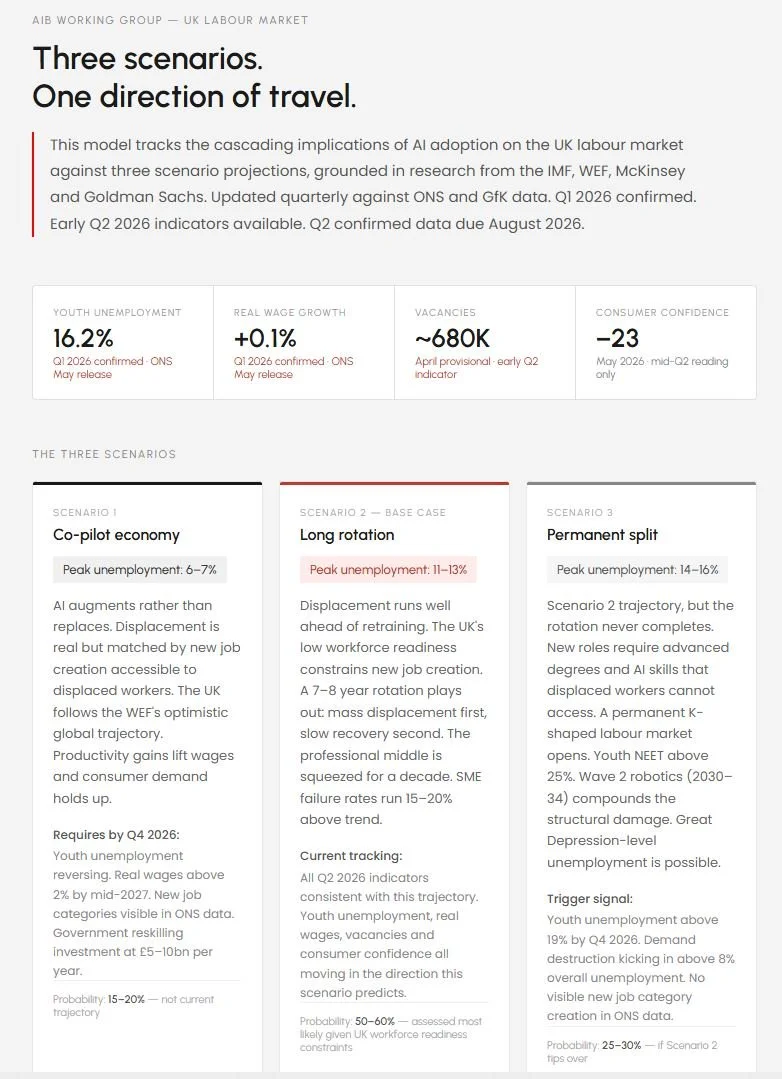
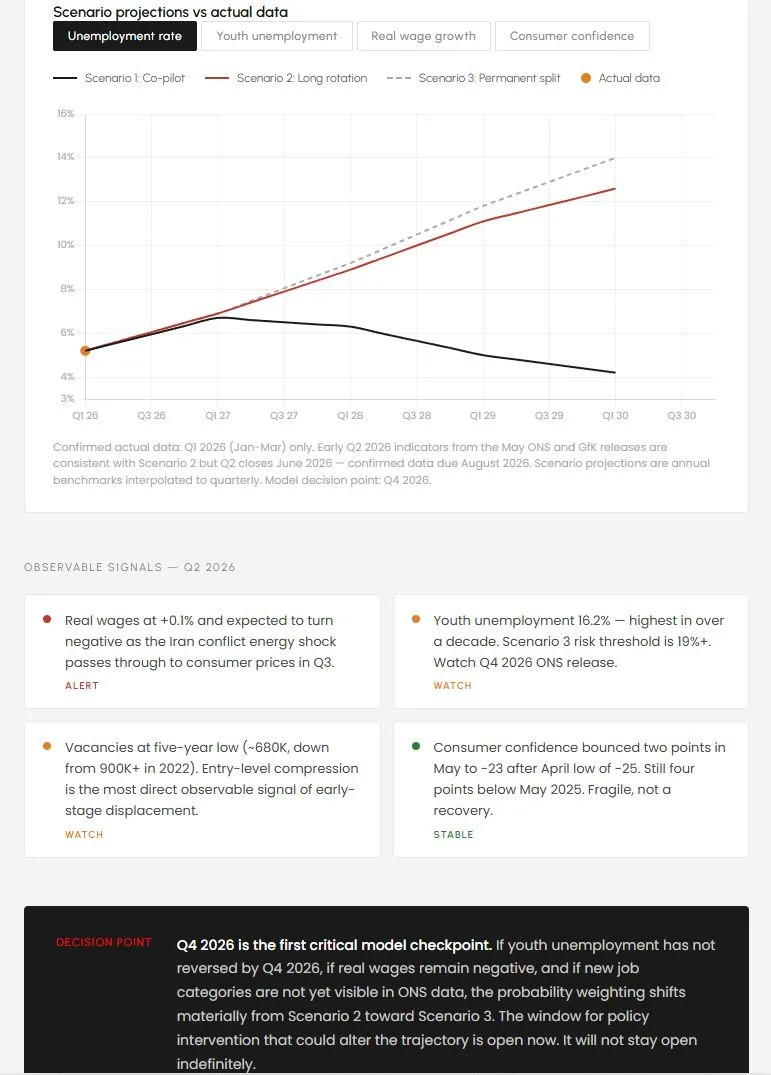
The economy is shifting in ways that most business leaders are not tracking closely enough. AI is reshaping labour markets faster than the headlines suggest. Youth unemployment is at a decade high. Real wages have nearly flatlined. Vacancies are at a five-year low. These are not abstract risks - they are already in the data, and they have direct implications for the businesses navigating this environment.
Most leaders have a view on where things are heading. Very few have a model.
This tracker maps three credible scenarios for how AI adoption plays out across the UK labour market - from a co-pilot economy where productivity gains absorb the disruption, through a long rotation where displacement runs well ahead of retraining, to a permanent structural split that does not close. Each scenario is grounded in research from the IMF, the World Economic Forum, McKinsey and Goldman Sachs, and tracked quarterly against actual ONS and GfK data as it is published.
The Q1 2026 data is the first confirmed point, and it is consistent with one scenario. Each quarter that follows tells us whether that trajectory is holding or tipping toward something worse.
Updated quarterly · Three scenarios · Live against ONS and GfK data
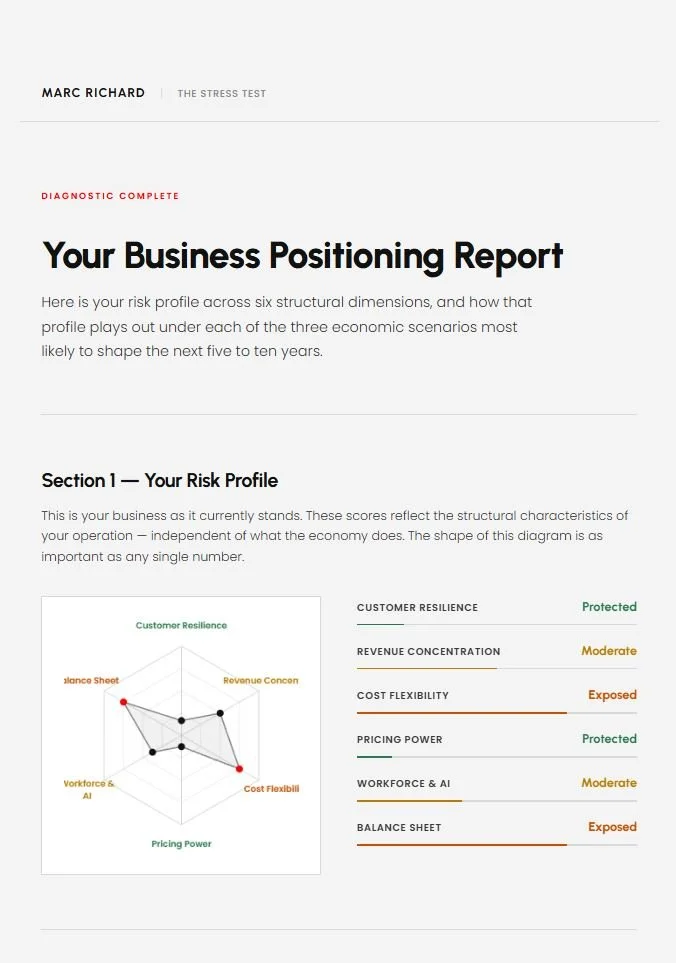
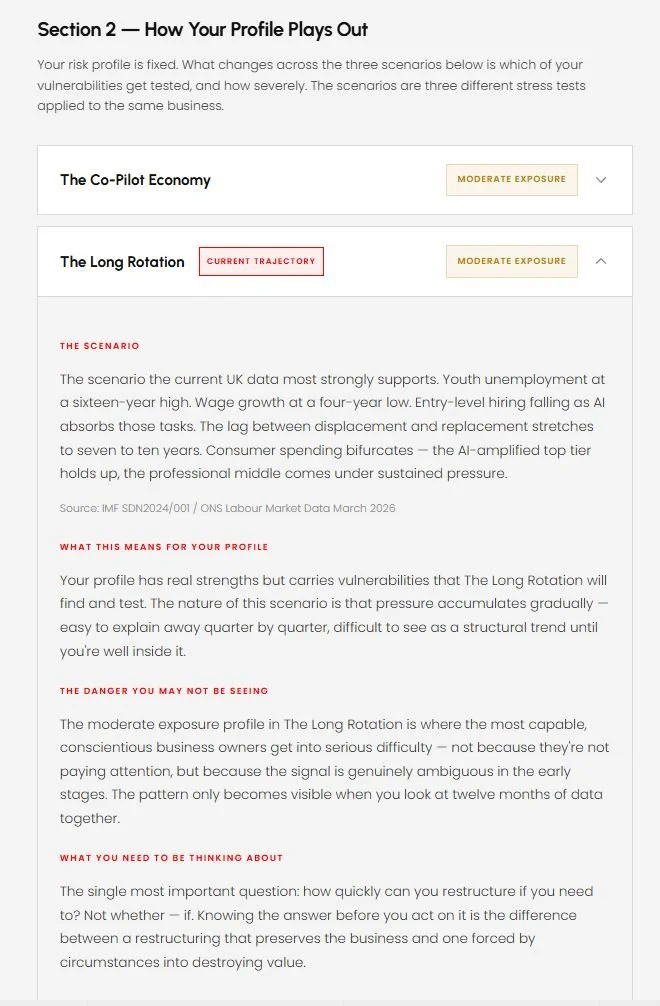
The economy is shifting. Not suddenly - gradually, then all at once. AI is reshaping labour markets, consumer spending is bifurcating, and the middle market that sustains most SMEs is under a pressure that does not show up clearly in the headlines until it is already in your revenue line. Most business leaders know something is changing. Very few have a clear, honest picture of whether their specific business - with its particular cost structure, customer base, pricing position, and financial resilience - is built to navigate what is coming. The gap between assuming you are fine and knowing you are fine is where most of the damage happens. The Stress Test closes that gap.
It maps the structural characteristics of your business against three credible economic scenarios, built on research from Goldman Sachs, McKinsey, the IMF, the World Economic Forum, and Daron Acemoglu - MIT economist and 2024 Nobel Prize winner in Economics. It scores your business across six vulnerability dimensions, shows you how your specific profile holds up under each scenario, and names the single most urgent thing you need to address first.
You will come away with a clear picture of where your business is genuinely exposed, which scenario the current data most strongly supports, and what the one priority is that everything else depends on.
10 minutes · 25 questions · Six dimensions scored · Three scenario output
The AI Era Strategy Workshop
The Stress Test tells you where you stand. The workshop is what you do about it. A full day with your leadership team: the cascading risks mapped to your business, your competitive position audited, a 90-day roadmap produced before you leave the room.
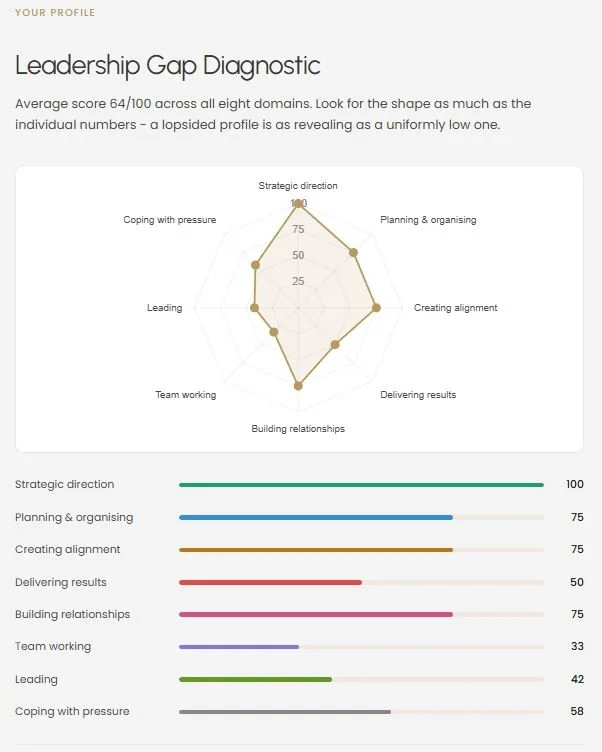
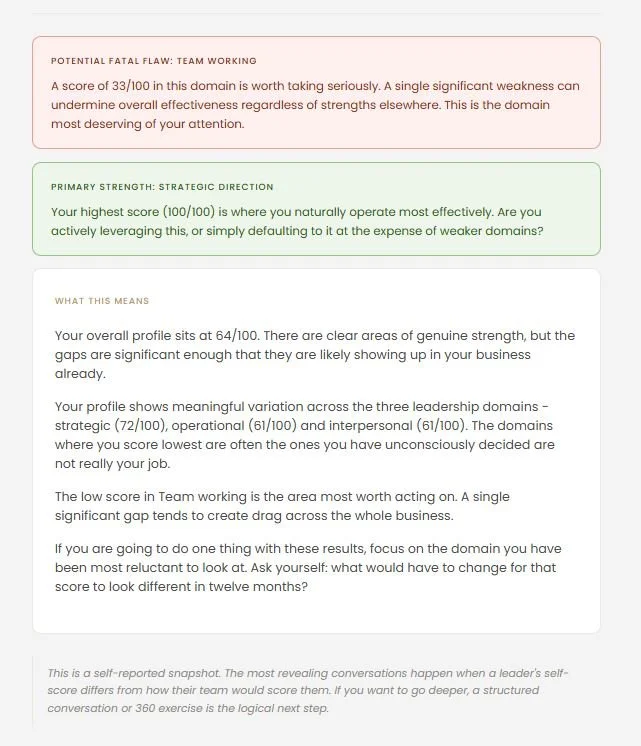
Eight minutes. Twenty-four scenario-based questions across eight leadership domains - strategic direction, planning, alignment, results, relationships, team, leading and coping with pressure. Followed by an optional self-awareness section that surfaces something more uncomfortable: the gap between the way you prefer to lead and what the people around you actually need from you. There are no obviously right answers. That is by design. 8 minutes · 24 questions · Optional self-awareness section
"The hardest part emotionally was accepting that as a pragmatic individual I couldn't solve the issue myself.
Marc helped me accept that asking for help is not a sign of weakness or an imposition, but an opportunity for growth and a critical step in the process of change.”

These tools are just the starting point.
A diagnostic tells you where you are. It does not tell you how to get somewhere better, and it cannot do the work for you. What it can do is give you and an adviser a shared, honest picture to work from - one that is harder to argue with than an opinion and harder to ignore than a feeling you have been pushing aside.
How you build on that picture, whether that means understanding your economic exposure before it forces your hand, repositioning a business that has become exposed, restructuring for growth, or developing yourself as a leader, is where the real work happens.
I work with a small number of owner-managed businesses at a time, going deep rather than wide. If something in these results has named something you have been circling around, that is the right moment to talk.
Ready To Know Where You Stand?