
Working With Me
I work alongside leaders who are committed & driven to transform their business through times of distress, high growth or technological adaption.
To build something that still stands when they step back from it.
If this is you, I would love to work together.
Strategic Transformation
You are not in crisis but the model needs to evolve. Technology is reshaping competitive advantage faster than most businesses can track. The leaders who navigate this well are not the ones who react fastest - they are the ones who understand what their business needs to look like in five years and make deliberate decisions about getting there, while running the thing at the same time.
Fractional Chairman or Board Adviser - one to three days per month, working across a small number of businesses simultaneously.
Equity Partnership - selective investments where I take a meaningful operational role alongside the advisory work.
Workshop - Full-day AI Era Strategy Workshop for leadership teams: situational audit, defensibility audit, and a 90-day roadmap your team leaves with and can execute.
Learn more here

Businesses Under Pressure

Sometimes the model has not just stalled, it has started to cost you, and the conversations you have been putting off are the ones that matter most. The hard part is never the technical work on cash and stakeholders; it is making difficult decisions while exhausted, on incomplete information, when the wrong call lands on real people.
I have done exactly that from inside my own business. Where a situation has reached genuine distress, with cash, creditors and legal process at the centre of it, I work in service alongside specialist restructuring partners rather than pretending that is the room I lead. The first conversation is free, and if I am not the right person I will say so and point you to someone who is.
Interim CEO - full-time when the situation requires complete operational accountability.
Strategic & Operational Restructuring: repositioning an underperforming or exposed business while there is still time to act, working in service alongside specialist restructuring partners where formal distress is present.
How The Work Unfolds
Phase 1 - Clarity
Phase 1: Clarity The business feels chaotic because you don't know what's actually wrong. We strip away the management accounts, the rationalisations, the wishful thinking. Within days, not weeks, you'll know exactly what you're facing: how much time you have, what's causing the damage, and what your real options are. Most leaders feel relief just knowing the truth, even when it's grim.
Phase 2 - Stability
Phase 2: Stability The business is haemorrhaging cash, trust, or capability. We stop the bleeding first: secure immediate funding, shore up key relationships, make the hard people decisions that have been delayed too long. This isn't about perfect solutions. It's about buying enough runway to think properly about what comes next. Stability work is brutal and unglamorous, but it keeps you alive.
Phase 3 - Transformation
Phase 3: Transformation The crisis is contained but the business still doesn't work properly. Now we rebuild: fix the operating model, strengthen the team, install systems that actually function. This is where most turnarounds either succeed or fail, because it requires changing how people work whilst they're still exhausted from the crisis. It's hard, slow, and completely necessary.
Phase 4 - Innovation
Phase 4: Innovation The business works, but it's not distinctive. This phase is rare because most companies either don't survive to reach it or don't want to keep pushing once they're stable. For those who do: this is where you build genuine competitive advantage, test new models, and position for growth rather than survival. This is where turnaround becomes transformation.
Not sure where you stand?
Before we talk, it is worth knowing where you actually stand. Three free tools on the Tools For Leaders page give you an honest picture before we have a conversation.
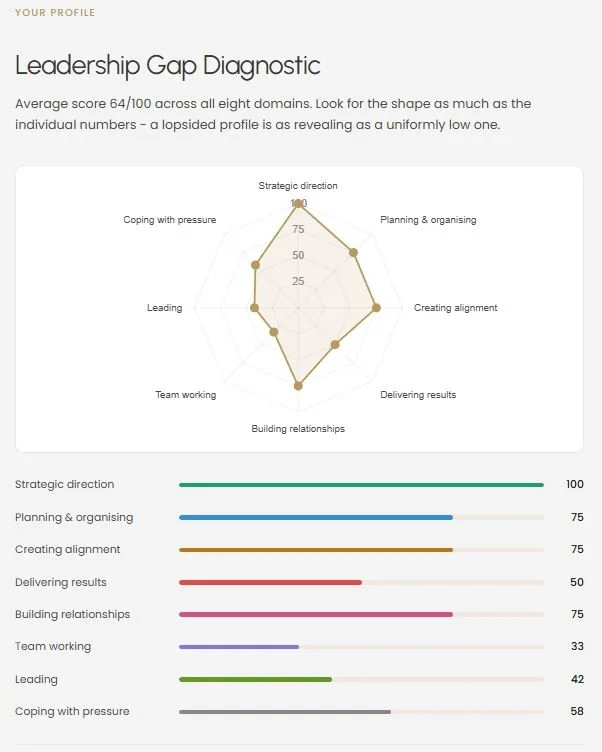
The Stress Test asks the question most owners are not asking: is the world your business is built for still going to exist in five years? The Leadership Gap Diagnostic shows you where your own leadership might be working against you. The Economic Scenario Tracker shows which way the data is actually moving. Each gives you an honest picture before we talk.
If something in the output looks familiar, that is worth a conversation.
What Makes This Different
I am not arriving with a consulting firm playbook. Twelve years as MD of a business I owned and was accountable for means I have been in the room when the decisions were impossible and the options were running out, and that is the context for how I work rather than a credential I lead with.
I work on both the numbers and the people, because you cannot reposition a business with a broken culture and you cannot fix culture while you are running out of room. Most advisers treat one as primary and the other as secondary. I do not.
And I read the cognitive-automation era the way I learned to read a market under pressure: from the position, the financials and the competitive landscape first, letting the technology decisions fall out of that rather than drive it. The question most owners are not asking is whether the world their business was built for will still exist in five years.
Who Works With Me
Owner-managers who can see the model needs to change and want to get ahead of it rather than wait until it forces their hand.
Accountants & Restructuring advisers who need someone working alongside the leader, not just the balance sheet.
Private Equity Firms where a portfolio company needs transformation, or where the leadership team is not executing the plan.
If any of that sounds familiar, the first conversation costs nothing.