The Cognitive Automation Era
What AI-driven automation means for how your business actually makes money.
Most businesses are adapting to AI from the bottom up: which tools, which workflows, where the hours come back.
That answers the wrong question. The one that decides the next decade is what happens to your business when the cognitive work inside what you sell can be bought by anyone for almost nothing, and which of your defences hold when it does.
This page makes the case. The workshop turns it into a plan for your specific business.
Why This One Is Different
Every previous wave automated muscle or routine. The loom, the production line, the spreadsheet. Each time the answer was the same: move people up into judgement work, the analysis, the thinking the machine could not do.
That escape route is now being automated. The drafting, the analysis, the first draft of the judgement. It is what most owner-managed businesses sell, build their margin on, or staff their middle layer with.
When the loom arrived, you could still sell expertise. The question now is what you sell when expertise itself gets cheap.
Two questions, not one
The exposure splits in two, and most leaders only think about the first.
The first is the business fundamentals: capital adequacy, customer concentration, recurring revenue, cost flexibility, differentiation, leadership quality. These have always mattered. A recession tests them. They are not new, and they are not where this era does its real damage.
The second is the part almost nobody has audited honestly: which of your defences hold as cognitive work gets automated, and which dissolve. Your labour-cost model. Your sales cycle. Your customer's own exposure to displacement. The thing you assumed was a moat that turns out to be a cost everyone can now strip out. The first list is good business practice. The second is the one that decides whether you are still here.

Stop Calling It A Moat
A moat implies something you build once and stop defending. In an environment moving this fast, a moat you have stopped defending is a drowning risk.
The honest version is defensibility, plural and dynamic. Some mechanisms hold as automation advances: genuine network effects, regulatory position, switching costs built into how the customer operates. Some dissolve: a data advantage foundation models override, an expertise premium that just got cheap, a head start measured in months.
The work is to score each one honestly as rising, holding, or declining, and to know the difference before the market tells you. Most claimed advantages are growth wearing a moat's clothing. The ones that compound are rare, and they are the only ones worth building on.

The competitor who starts from nothing
Stop looking at your existing competitors. They carry the same legacy you do. Look at the business someone would design from a blank sheet today to take your market.
No headcount built for a pre-automation world. No layer of people doing the cognitive work that is now cheap. No inherited cost base. They automate the middle of what you charge for, price the rest below what you can match while carrying your structure, and reach your customer with the same outcome and a different number.
The exercise is not whether they could exist. It is to describe them honestly, then count how many of your defences are still standing when they arrive. Most teams have never run it. The ones who do find the answer more urgent than the calm of the current numbers suggests.
Defensibility Is Moving Too
Defensibility itself is moving, not just the labour market underneath it. Cornered resources, hold. Regulated positions and trust that's been tested rather than claimed, hold. Interface switching costs, generic proprietary data, the expertise premium you used to charge for judgement, all of it erodes faster than most businesses have priced in.
The mechanisms that protected you five years ago are not the ones that will protect you in two. Most businesses have not audited which side of that line they're standing on.

The response is top-down
The exposure splits in two, and most leaders only think about the first.
The first is the business fundamentals: capital adequacy, customer concentration, recurring revenue, cost flexibility, differentiation, leadership quality. These have always mattered. A recession tests them. They are not new, and they are not where this era does its real damage.
The second is the part almost nobody has audited honestly: which of your defences hold as cognitive work gets automated, and which dissolve. Your labour-cost model. Your sales cycle. Your customer's own exposure to displacement. The thing you assumed was a moat that turns out to be a cost everyone can now strip out. The first list is good business practice. The second is the one that decides whether you are still here.

Then It Gets Personal
Everything above is the general case. Your exposure is specific: your fundamentals, your defensibility mechanisms scored honestly, the blank-slate competitor described for your market, and which of the three scenarios you are actually built for.
The AI Era Strategy Workshop is where a leadership team runs the full diagnosis against their own business. It is not built on conversation and flip-charts. It runs on the diagnostic instruments built for exactly this: the situational audit; a defensibility assessment against the mechanisms that actually hold under automation, not the ones that used to; the blank-slate competitor brief, the same instruments deployed with clients beyond the workshop itself; a roadmap built from what they reveal.
The thinking on this page is the reason to do it. The day is where it stops being an argument and becomes a plan.
Where This Gets Specific
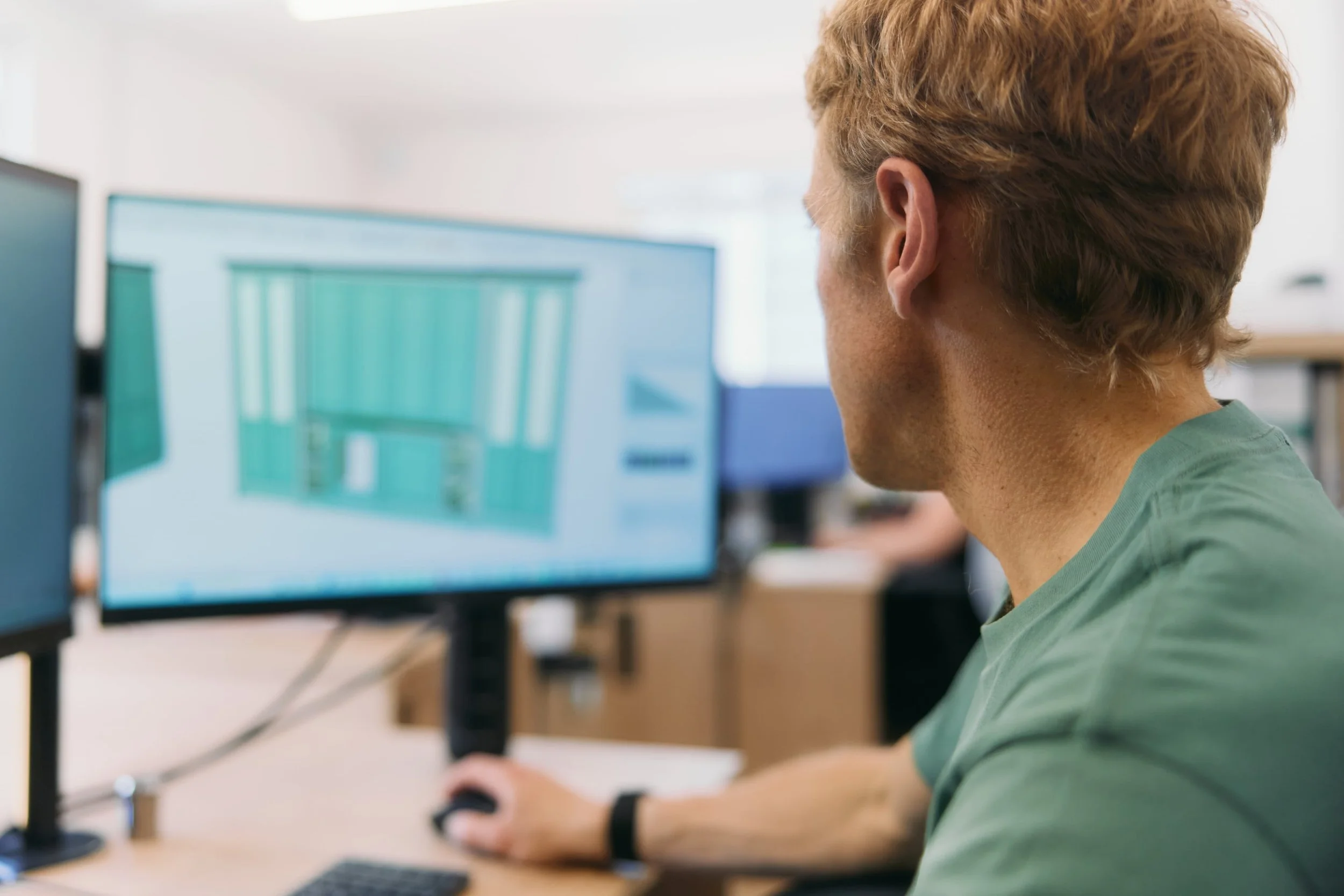
A precision panel processing business we've worked with had eleven years of CAD files and quoting history sitting in the business, doing nothing but recording old jobs.
That data, and the technical director's own construction knowledge, was the closest thing the business had to a cornered resource, an advantage a well-funded competitor couldn't rebuild in two or three years because rebuilding it means eleven years of client work, not eleven years of software spend.
The business now sells access to that knowledge on a retainer, not design work by the hour, and roughly 80% of the administrative overhead that used to sit around every job has gone. That's not a tool adoption story. That's a business model that changed because someone took the data seriously.
Ready To Discuss?

TESTIMONIALS
-
![A man with dark, wavy hair and light skin, smiling and wearing a white button-up shirt with small black dots, sitting against a blue tiled wall.]()
Gary Chivers, Former Business Partner
“He cares deeply about seeing his people thrive, he is relentless and he is extremely capable. I would happily run into burning buildings alongside Marc, and smash through walls to drag people out.”
-
![A middle-aged man with curly brown hair, a beard, and blue eyes wearing a white shirt standing indoors near large windows.]()
Ed Birks, Director
"Marc possesses an innate ability to cut through noise and identify the truth of a situation. He saw straight through the smokescreen that had been created and took decisive action at speed.
His work helped protect the wider group and significantly reduced personal and financial exposure for those involved. Beyond the crisis, his coaching and lived experience helped me move forward quickly - I've since appointed him as advisor to my business and Chair of the Board."
-
![A woman with blonde hair smiling, wearing a light-colored top]()
Annette Pettitt, Accountancy Firm Principal
“Marc is an exceptional coach and a steady hand in demanding circumstances.
He knows how to guide teams through uncertainty with clear thinking, practical direction, and a leadership style that inspires trust. His impact on an organisation’s ability to adapt and thrive is invaluable.”
-
![Close-up portrait of a middle-aged man with light skin, blue eyes, and brown hair, smiling and wearing a gray suit, white shirt, and red tie, against a light background.]()
Chris Dunn, CEO of TDA Transitions & Learning
"In your consulting niche you have a lot to pass on - especially that 'first hand' lived experience. That sets you apart. There is no substitute for experience.”
-
![]()
Jasper Heinrich, Operational Leader
"Marc brought immediate clarity and direction during a period of real pressure. His calm leadership, structured approach, and clear plan gave the team confidence when it mattered most. We faced some big decisions, and his ability to cut through complexity and create clarity made all the difference."
-
![A young man with short blonde hair and a black athletic shirt smiling and looking to the side in what appears to be an indoor sports or fitness facility at night.]()
Tom Canning, Aston Martin Racing Driver
“I’m very grateful for the involvement from Marc and the impact he had on me and my career over these years as well as a relationship for life. I developed more than I could have imagined in almost all areas.”
-
![A man sitting in a large, dark leather armchair in a dimly lit room, leaning back with one hand on his chin and smiling slightly.]()
Martin Badder, Music Composer & Producer
"Marc is a very special person. His compassion and caring nature shine through in everything he does, and I felt a genuine connection with him. I am thankful for his impact on my journey."